
Neurourbanistic Research for Healthier Cities
More and more people are moving away from the countryside and into urban centers. This global urbanization comes with a multitude of challenges. Studies have shown that city dwellers are more likely to suffer from mental illnesses but the mechanisms behind this are still poorly understood. The burgeoning field of Neurourbanism (which developed as a subfield of Environmental Neuroscience) aims to address, through inter- and transdisciplinary collaboration, the question of how cities can be made more liveable and what urban design decisions might harm or promote wellbeing.
In our lab, we apply neuroscientific methods to investigate how urban density factors influence people’s emotional and stress experiences in urban environments, using stationary, as well as MoBI protocols in VR and the real world. Another focus lays on the investigation of methodological implications in neurourbanistic research.
Methods in Neurourbanistic Research
One specific focus of research in our lab concerns evaluating the methods used in neurourbanistic research.
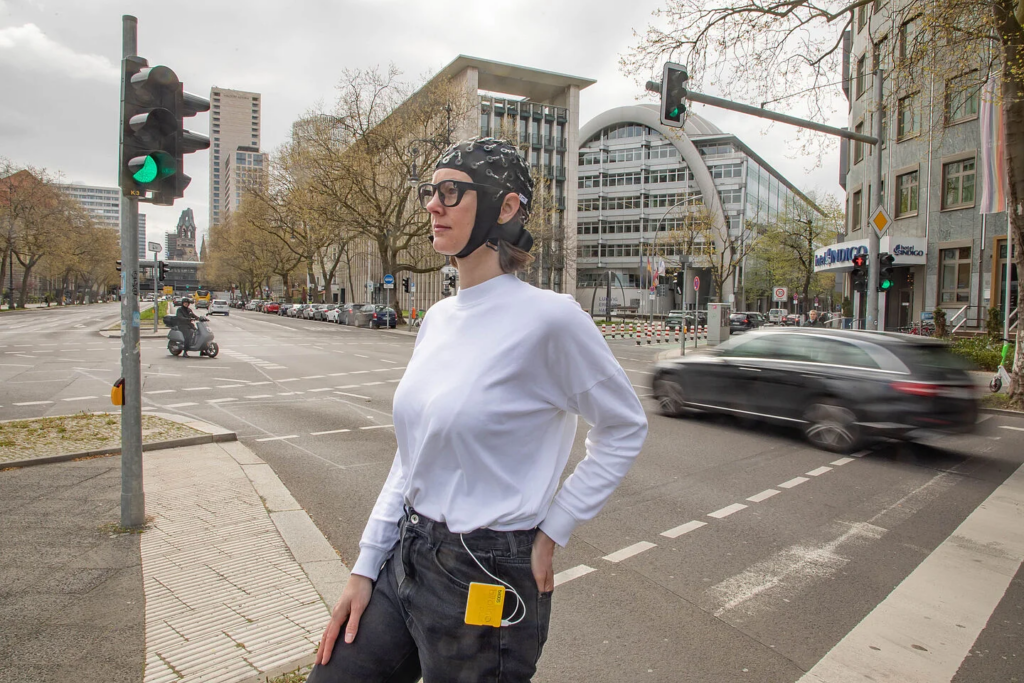
Many studies in the field use consumer-grade EEG systems with few electrodes. In our lab we aim to contribute to Neurourbanism by conducting studies with high-density, medical grade mobile EEG equipment. We have additionally specialized in multi-modal physiological recordings, integrating measures like ECG, EDA, and eye tracking with mobile EEG.
Another topic of interest is the ecological validity of different experimental protocols. While real world studies are the “gold standard”, they are logistically and economically costly. We aim to investigate how physical and affective response to real world urban environments compare to virtual environments. This provides valuable insights for the design of future studies as well as other applications for evaluating urban design.
Contact: Isabelle Sander