News
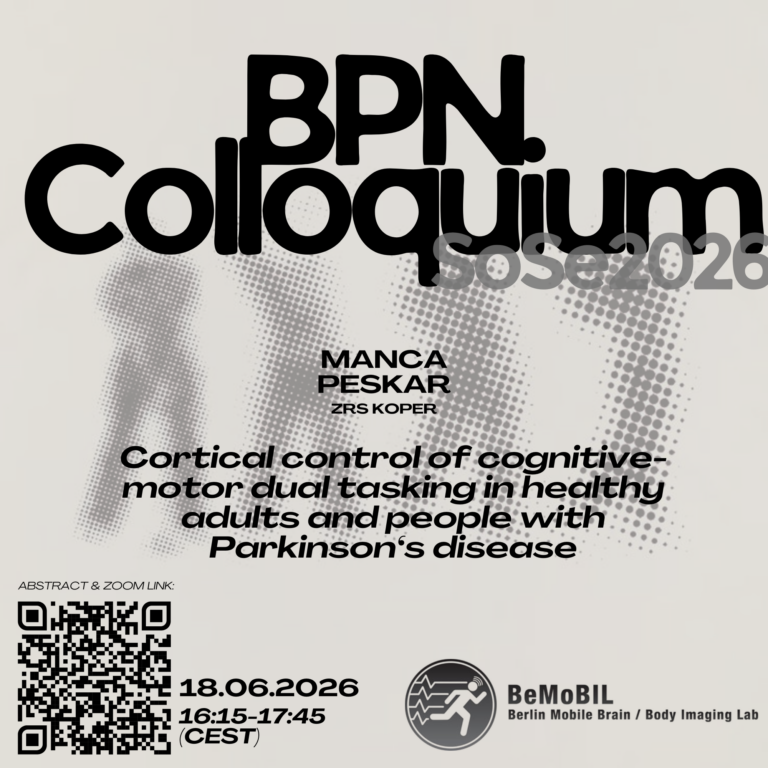
18.06.2026
Weekly Colloquial Talk:
Cortical control of cognitive-motor dual tasking in healthy adults and people with Parkinson‘s disease
online, 16:15-17:45
Manca Peskar
ZRS Koper
Abstract :
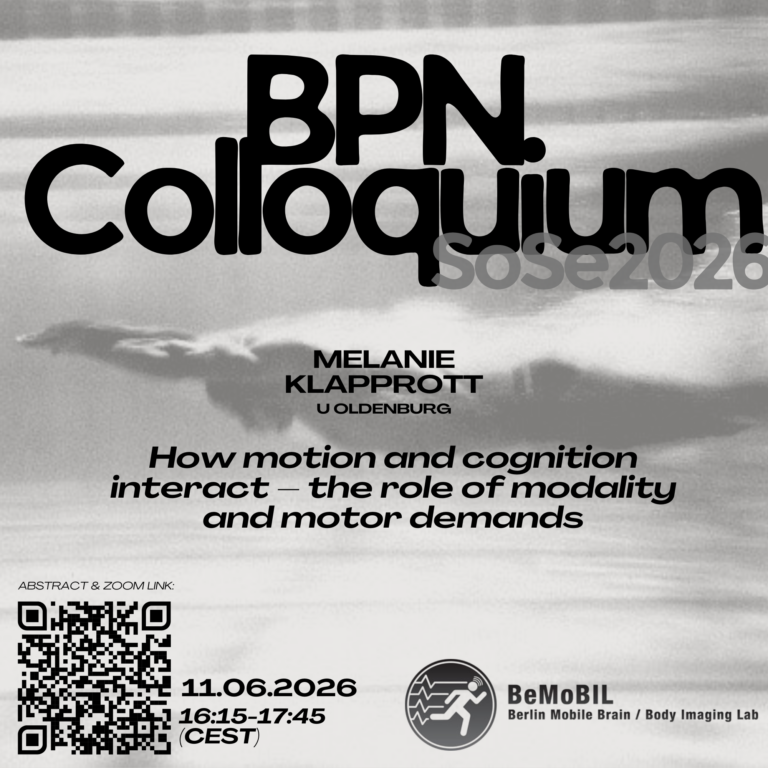
11.06.2026
Weekly Colloquial Talk:
How motion and cognition interact – the role of modality and motor demands
online, 16:15-17:45
Melanie Klapprott
University Oldenburg
Abstract :
Over the past decade, there has been growing interest in understanding the interaction between (loco-)motion and cognition in real-world settings. Technological advances in mobile brain/body imaging (MoBI) allow researchers to simultaneously assess neural activity and behavior during natural movement, both inside and outside the laboratory.
In this talk, Melanie presents her research on the interaction of (loco-)motion and cognition from two perspectives. First, she addresses cognitive-motor dual-tasking (CM-DT) and the question of how concurrent motor and cognitive demands influence performance and brain activity at the example of swimming. An additional focus is placed on the methodological challenges and opportunities of recording mobile EEG in extreme settings. Second, she examines the effects of physical exercise on brain activity and cognitive performance. Focusing on swimming and cycling as distinct exercise modalities, she discusses whether different physiological demands lead to differential neurocognitive adaptations.
Finally, these two perspectives are brought together in an outlook on a planned CM-DT training intervention study. By systematically varying sensorimotor demands during an acute CM-DT training, this work aims to investigate whether more demanding movement conditions elicit stronger improvements in cognitive performance and processing speed.
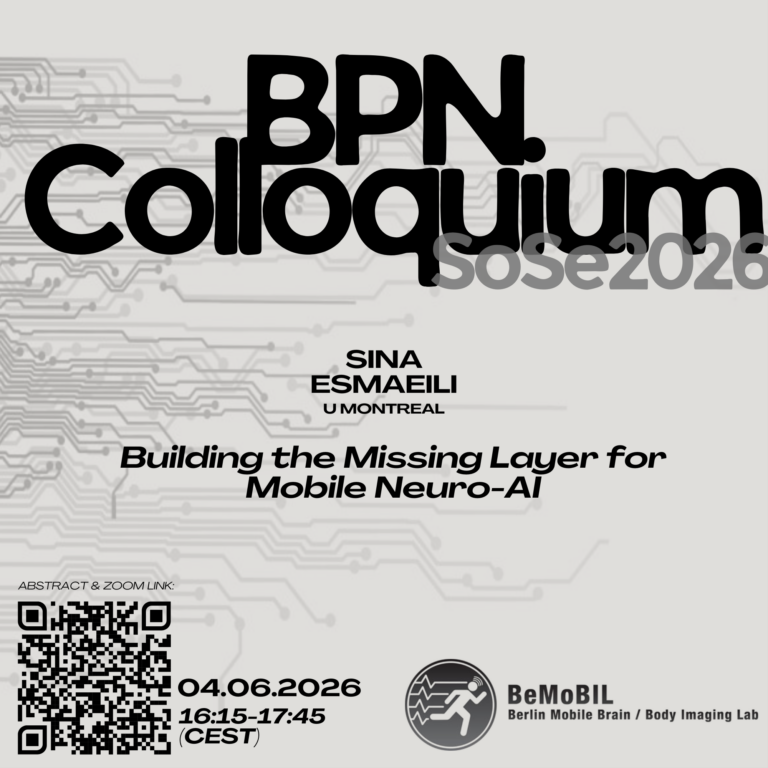
04.06.2026
Weekly Colloquial Talk:
Building the Missing Layer for Mobile Neuro-AI
online, 16:15-17:45
Sina Esmaeili
University Montreal
Abstract :
Cognition does not happen only in still bodies seated in front of screens. Many of the mental processes we want to understand unfold while people move, walk, interact, and navigate complex environments. Mobile Brain/Body Imaging (MoBI) offers a way to study these dynamics in more naturalistic settings by combining EEG, movement, behavior, and environmental signals. However, MoBI experiments produce noisy, multimodal, and nonstationary data, and the field still lacks a mature Python-native software layer for processing these recordings in a transparent and reproducible way.
In this talk, I will present ongoing work toward building this missing layer for mobile neuroimaging and future Neuro-AI applications. I will first discuss why mobile EEG requires better open-source tools for denoising, source separation, quality control, and reproducible analysis. The talk will then highlight three connected efforts: mne-denoise, a framework for transparent EEG denoising and artifact evaluation; AMICA-python, a modern Python/JAX implementation of adaptive source separation; and MNE-MoBI, a broader effort to support mobile EEG and multimodal brain-body workflows within the MNE ecosystem.
Together, these tools aim to make mobile neuroimaging more reproducible and scalable, while providing cleaner and better-documented large-scale EEG datasets for downstream AI modeling and future foundation-model pretraining. Time permitting, I will conclude with a short demo of some of these tools.
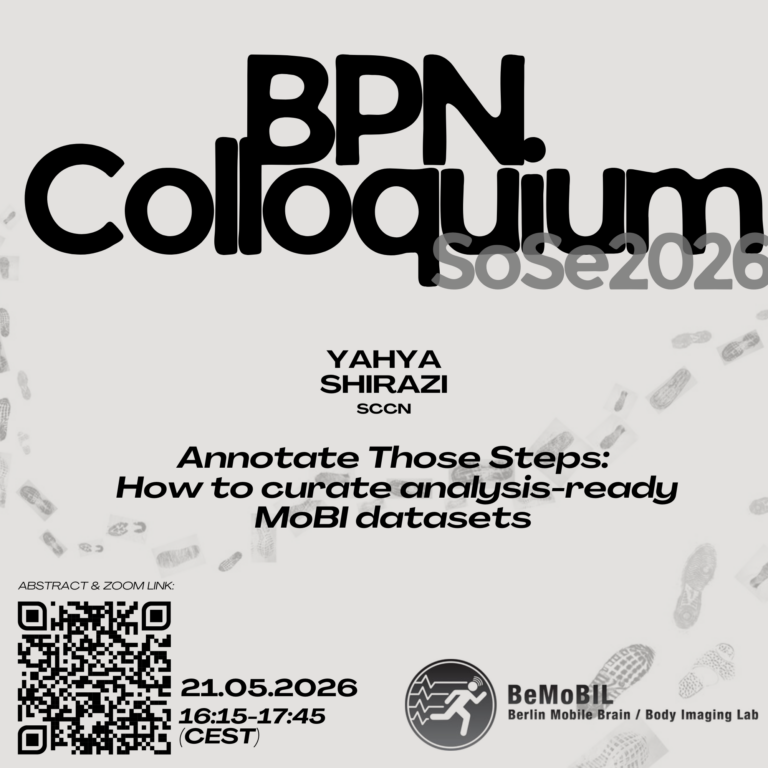
21.05.2026
Weekly Colloquial Talk:
Annotate Those Steps: How to curate analysis-ready MoBI datasets
online, 16:15-17:45
Yahya Shirazi
SCCN (UCSD)
Abstract :
07.05.2026
Weekly Colloquial Talk:
The reciprocity between perceiver and environment: Dynamics of exploratory movement in braille reading
online, 09:00-10:30
Tetsushi Nonaka
Kobe University
Abstract : How do we control our encounters with a world that is structured at multiple scales? To address this question, I will first outline an approach grounded in the reciprocity between agent and environment, in which the dynamics of perception and action are studied as the unfolding of a larger system of agent-plus-environment. Second, I will present an empirical example of how exploratory behavior is tuned to a structured environment: an ongoing study of braille reading. I will discuss how the multiscale temporal structure of finger movement may play a role in active information pickup.
30.04.2026
Weekly Colloquial Talk: Attention in the Wild
online, 16:15-17:45
Amy McDonnell
Colorado State University
Abstract : A growing body of behavioral and self-report research suggests that exposure to natural environments enhances attention, yet the underlying neural mechanisms that drive these benefits remain poorly understood. This talk will synthesize a program of research using EEG to examine how different forms of nature exposure, from stimulated nature (images and virtual reality) to real-world nature (short walks and multi-day immersion), shape attentional processes in the brain.
23.04.2026
Weekly Colloquial Talk: Graph-Based Analysis of 3D Facial Phenotypes and EEG Dynamics for Clinical and Cognitive Applications
online, 16:15-17:45
Jacopo Burger
University of Milan
Abstract : This talk provides an overview of my recent work on multimodal data analysis combining 3D facial imaging and EEG. High-resolution facial meshes are used to extract geometric features through automated landmarking techniques, enabling non-invasive analysis of morphological patterns associated with rare conditions such as Marfan syndrome via Graph Neural Networks (GNNs). In parallel, EEG data are modeled through Effective Connectivity Networks to capture directed interactions between brain regions, supporting the classification of Alzheimer’s disease, Frontotemporal dementia, and healthy controls within a graph-based framework. Ongoing work focuses on EEG recordings collected during a dance learning paradigm, aiming to characterize differences in brain activity between familiar and unfamiliar stimuli and to assess the impact of prior expertise. This line of research explores how complex, naturalistic behaviors can be represented and analyzed both through graph-based models and more standard approaches.
16.04.2026
Weekly Colloquial Talk:
Neurocognitive mechanisms underlying allothetic and idiothetic spatial cues integration during human spatial navigation across lifespan
online, 16:15-17:45
Clément Naveilhan
Université Côte d’Azur
Abstract : How does the human brain maintain a stable sense of direction during naturalistic navigation, and why does this ability decline with age? To address these questions, we conducted a series of three studies, combining immersive virtual reality with high-density mobile EEG while participants actively moved in path integration paradigms. First, we found that, in young adults, theta-band activity provides a flexible neural mechanism supporting the correction of the path integrator with visual landmarks. In a second protocol, we assessed howsimilar correction mechanisms could be recycled in the absence of visual landmarks, and found that theta bursts in the retrosplenial complex encode alignment with principal body axes, establishing an adaptive, egocentric scaffold for orientation. Finally, we transferred these findings to aging, demonstrating that navigational difficulties of older adults are directly linked to altered gait dynamics, and reflected in increased mid-frontal theta activity. Although older adults attempt to compensate for degraded locomotor integrity by relying heavily on visual landmarks, this strategy remains inefficient. Ultimately, these results advance a mechanistic cognitive–motor framework for human navigation, highlighting body-centred neural coding and locomotor integrity as critical determinants of spatial orientation, and opening new avenues for investigating brain dynamics in naturalistic, movement-rich settings using non-invasive neural recordings.
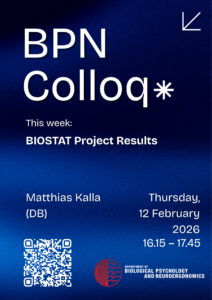
12.02.2026
Weekly Colloquial Talk:
Result Presentation of BIOSTAT Project
Matthias Kalla
Deutsche Bahn
PhD Candidate Matthias Kalla presents results of his project in collaboration with Deutsche Bahn where he investigated the influence of train platform design on subjective and physiological responses.
20.01.2026
Weekly Colloquial Talk:
A multi-method approach to investigating aesthetic experiences in everyday life
Tristan Barrière
Empirical Visual Aesthetics Lab, University of Vienna
Aesthetic experiences are a fundamental part of our lives, shaping how we perceive the world and influencing our wellbeing. Although deeply personal, these experiences universally affect mood, attention, and physiology. While often associated with nature or art, they can also be elicited by mundane, everyday objects. Although preferences for natural over urban scenes are common, the underlying mechanisms remain unclear. Urbanization further complicates this, as noise, crowding, and pollution can disrupt positive aesthetic experiences. Conversely, urban green spaces and art may mitigate these stressors by fostering wellbeing; however, research directly comparing nature and art in this context is lacking. Furthermore, aesthetic research has traditionally focused on laboratory settings, missing the real-world dynamics essential to daily life. My project aims to determine whether aesthetic experiences are measurable in everyday life and how they influence our lives. Through the use of a multi-method design—combining eye-tracking, physiological and subjective measures, and mobile imaging—we investigate how environmental content, context, and setting moderate both the experience and its effects. We compare a variety of real-world contexts with laboratory settings to gain a holistic understanding of how aesthetic experiences manifest in real-world contexts.

19.08.2025
Workshop: Mobile Brain/Body Imaging
Berlin, Germany, Sep 30 – Oct 2, 2025

20.04.2025
6th International Mobile Brain/Body Imaging Conference 2026
Berlin, Germany, 26-28th August, 2026

15.11.2023
TwinBrain WORKSHOP 4.0
Koper, Slovenia, November 27th – 30th 2023
In November 2023 all neuroscience of movement enthusiasts are invited to join the fourth TwinBrain workshop.The event will take place in the beautiful city of Koper and will offer both on-site and online participation. The full program has just been announced and registration is now available! Please follow the link below for details about the workshop.
25.09.2023
Mobile Brain-Body Imaging Conference
Piran, Slovenia, June 2nd – 5th 2024
In June 2024, an international meeting for MoBI researchers will take place in the city of Piran, Slovenia, facing the beauty of the Adriatic sea. The conference will foster scientific discussions on how the brain and body interact with each other to give rise to naturalistic behavior and cognition. Submission is now open for your contributions! Please follow the link below for details about MoBI 2024.
18.06.2023
Neurourbanism on the radio
“Mehr als die Hälfte der Menschen weltweit leben in Städten – und es werden immer mehr. Das hat Folgen für die Gesundheit ihrer Bewohner. Ein interdisziplinäres Forschungsprojekt aus Berlin untersucht diese Folgen und sucht nach Konzepten für eine gesündere Stadt.” by Anna Corves
22.05.2023
Neurourbanism in the news
“Das neue Forschungsfeld der Neuro-Urbanistik untersucht, wie widerstandsfähige Städte gestaltet werden können, in denen Menschen gerne leben.” by Patricia Pätzold