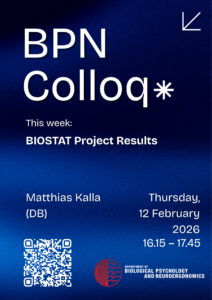
PhD Candidate Matthias Kalla presents results of his project in collaboration with Deutsche Bahn where he investigated the influence of train platform design on subjective and physiological responses.
20.01.2026
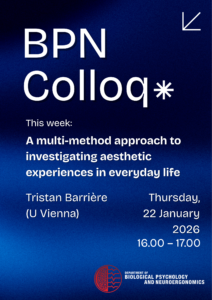
Weekly Colloquial Talk:
A multi-method approach to investigating aesthetic experiences in everyday life
Empirical Visual Aesthetics Lab, University of Vienna
Aesthetic experiences are a fundamental part of our lives, shaping how we perceive the world and influencing our wellbeing. Although deeply personal, these experiences universally affect mood, attention, and physiology. While often associated with nature or art, they can also be elicited by mundane, everyday objects. Although preferences for natural over urban scenes are common, the underlying mechanisms remain unclear. Urbanization further complicates this, as noise, crowding, and pollution can disrupt positive aesthetic experiences. Conversely, urban green spaces and art may mitigate these stressors by fostering wellbeing; however, research directly comparing nature and art in this context is lacking. Furthermore, aesthetic research has traditionally focused on laboratory settings, missing the real-world dynamics essential to daily life. My project aims to determine whether aesthetic experiences are measurable in everyday life and how they influence our lives. Through the use of a multi-method design—combining eye-tracking, physiological and subjective measures, and mobile imaging—we investigate how environmental content, context, and setting moderate both the experience and its effects. We compare a variety of real-world contexts with laboratory settings to gain a holistic understanding of how aesthetic experiences manifest in real-world contexts.
19.08.2025
Workshop: Mobile Brain/Body Imaging
Berlin, Germany, Sep 30 – Oct 2, 2025
Sponsored by #BrainProducts we will dive deep into the BeMoBIL setups and give insights into our systems and analysis pipeline. This 3-day workshop will equip you with the tools & techniques to collect & analyze EEG, ECG, EDA, and eye-tracking data in natural environments.
6th International Mobile Brain/Body Imaging Conference 2026
Berlin, Germany, 26-28th August, 2026
We are excited to invite you to join us in Berlin for the 6th International Mobile Brain/Body Imaging (MoBI) Conference, which will take place August 26-28, 2026, at the Oderberger Hotel in Berlin hosted by the Berlin Mobile Brain/Body Imaging labs, chair Biological Psychology and Neuroergonomics at Technische Universität Berlin.
In November 2023 all neuroscience of movement enthusiasts are invited to join the fourth TwinBrain workshop.The event will take place in the beautiful city of Koper and will offer both on-site and online participation. The full program has just been announced and registration is now available! Please follow the link below for details about the workshop.
In June 2024, an international meeting for MoBI researchers will take place in the city of Piran, Slovenia, facing the beauty of the Adriatic sea. The conference will foster scientific discussions on how the brain and body interact with each other to give rise to naturalistic behavior and cognition. Submission is now open for your contributions! Please follow the link below for details about MoBI 2024.
“Mehr als die Hälfte der Menschen weltweit leben in Städten – und es werden immer mehr. Das hat Folgen für die Gesundheit ihrer Bewohner. Ein interdisziplinäres Forschungsprojekt aus Berlin untersucht diese Folgen und sucht nach Konzepten für eine gesündere Stadt.” by Anna Corves
“Das neue Forschungsfeld der Neuro-Urbanistik untersucht, wie widerstandsfähige Städte gestaltet werden können, in denen Menschen gerne leben.” by Patricia Pätzold