Spatial Cognition
Project : Spatial representations of impossible environments
In this project we contrast predictions from two leading theories on the organisation of spatial memory: the cognitive map and the cognitive graph. By giving participants spatial navigation tasks in impossible non-Euclidean environments, we can understand how the processes of spatial learning and representation change, alongside the resulting navigation behaviour, when the core assumptions of these theories are violated. These questions are addressed using a combination of virtual reality, motion capture, eye-tracking, and EEG methods.
Contact: Chris Hilton
This project is funded by the Deutsche Forschungsgemeinschaft Project number 511678193.
Project : Dissociating Imagined and Executed Self-Motion during Spatial Encoding: The Role of Parietal Alpha
This project investigates how imagined and executed self-motion differentially influence spatial encoding and their underlying neural mechanisms. In an immersive virtual-reality paradigm, participants encoded spatial orientations while either visually observing scene rotation (VP), imagining the corresponding head rotation (MI), or physically executing the head rotation (ME). Spatial memory was subsequently assessed by asking participants to reproduce the encoded orientation.
Mobile EEG, eye movements, and head movements were recorded simultaneously. Data collection was completed with 34 participants. Behavioral results indicate that spatial memory is impaired during motor imagery but enhanced during motor execution relative to visual perception.
EEG analyses further reveal differential parietal alpha dynamics between MI and ME that are associated with subsequent memory performance, suggesting different spatial-attentional demands during imagined and executed self-motion and their modulation of spatial encoding.
In parallel, pre-programmed eye movements shared between MI and ME provide evidence for common movement-preparatory processes. Individual differences in MI vividness are also associated with better-preserved spatial memory, consistent with the possibility that more vivid imagery provides richer sensory information that supports spatial encoding. Together, these findings suggest that MI and ME share aspects of movement preparation while differing in how spatial attention is recruited during encoding.
Preliminary findings from this project have been presented at RIO 2025 and MoBI 2026.
Contact: Hsin-Ping Tien
Project : Population activity of neurons in actively navigating humans
In this project, we attempt to capture characteristic properties of specialised cells in human medial temporal lobe in high-density scalp EEG signal. Evidence from literature (Staudigl et al. 2018, Seeber et al., 2019) points towards the potential of accessing signals arising from deeper sources in electrophysiology data to investigate deeper brain regions. To this end, we refer to testable predictions on macroscopic signals that are derived from computational properties established from invasive recordings. This project is a collaboration between our group and Prof. Christian Doeller at the Max-Plack Insitute in Leipzig and Kavli Center for Systems Neuroscience at Trondheim University.
Contact: Sein Jeung
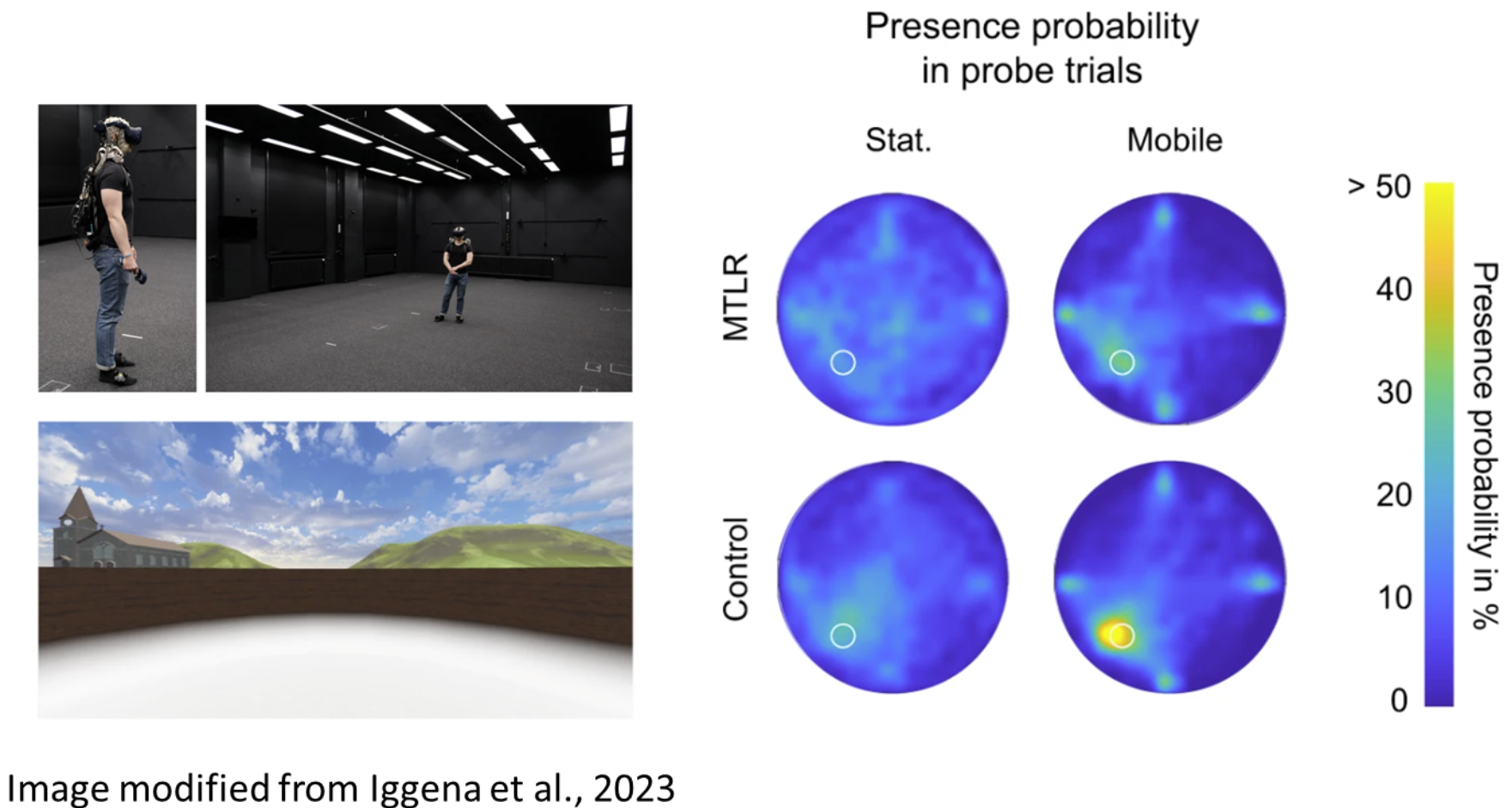
Project : Multisensory input and spatial memory of participants with medial temporal lesions
We created a virtual human-scale version of the Morris Water Maze (MWM), a classic paradigm for testing spatial memory in rodents. The goal of the study is to find out whether the medial temporal lesion will affect the performance of the patient group, and whether this effect persists when they navigate through physical space (wearing immersive head-mounted VR goggles) instead of experiencing the MWM as a simulation projected onto a flat screen. Results of the behavioural analysis (Iggena et al., 2023) point to the fact that both the clinical and healthy populations benefit from additional sensory information in VR but via different mechanisms. Associating the results with works that link the hippocampus and other medial temporal areas with allocentric (view-invariant) representations, the patient group makes use of more egocentric, body-based information to solve the task, which is easier in immersive VR. This is a collaborative project between our group and Dr. Deetje Iggena, MSc. Patrizia Maier, Prof. Christoph Ploner, Prof. Carsten Finke at the Charité Berlin, department of neurology.
Contact: Sein Jeung